
How Does AI Research Discovery Work? One Question, Five Steps

A history student types a question into an AI discovery tool:
“How did people in 19th-century cities cope with noise?”
A few seconds later, she has a short list of studies. Some use her words. Many don’t. They talk about “urban soundscapes,” “sensory history” and “acoustic modernity.” None of those phrases were in her question, yet the work is exactly what she needed.
How did the system get there? Most AI research discovery tools follow the same five broad steps. Knowing them makes you better at using any of them.
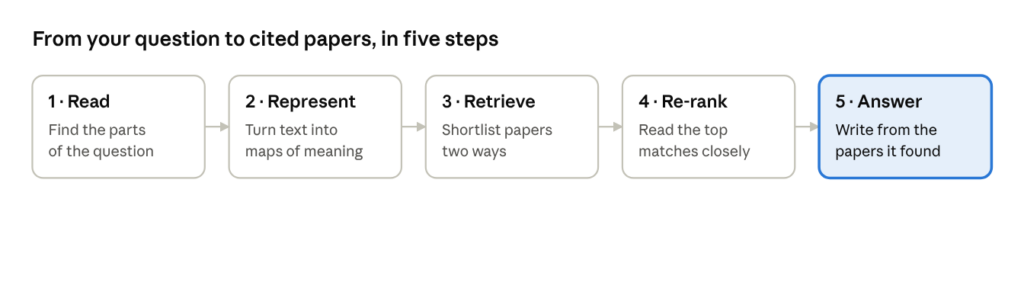
The details differ from tool to tool, and vendors don’t always publish them. But the building blocks are well documented in published research, and that’s what this guide draws on.
Step 1: Reading the question
First, the system works out what is being asked.
It breaks the question into its parts: a period (the 19th century), a setting (cities), a phenomenon (noise) and a human response (how people coped with it). It also reads what kind of answer is wanted. “How did people…” asks about lived experience, so historical studies built on diaries, complaints, newspapers and city records matter more than modern acoustic measurements.
Some systems also expand the question at this stage, adding related terms or rewriting it into a form that searches better. The researcher never sees this, but it shapes everything that follows.
Step 2: Turning text into meaning
Next, the system converts text into something it can compare: a long list of numbers called an embedding. Think of it as a set of coordinates on a map of meaning. Texts about similar ideas end up close together, even when they share no words.
This happens twice. Every paper in the collection is converted ahead of time, usually from its title and abstract. Then the question is converted when it is asked.
How a model learns where to place papers on that map matters a lot for research. One influential approach, SPECTER, was published by the Allen Institute for AI in 2020. Instead of learning only from the words in papers, it learned from the citation graph: if one paper cites another, the two are probably related, so they should sit close together. Its authors found that simply feeding titles and abstracts into a general language model, even one built for scientific text, gave weaker results than using citations as the signal.
That is why “noise” and “soundscape” can land side by side. Historians, musicologists and urban scholars writing about the sounds of the city cite each other, and the model has learned that their work belongs together.
Step 3: Shortlisting papers two ways
Now the system gathers candidates. You might expect an AI tool to rely only on meaning. The evidence says that would be a mistake.
In 2021, researchers at the Technische Universität Darmstadt published BEIR, a benchmark that tested 10 retrieval methods across 18 datasets, including scientific ones. Their finding surprised many people: BM25, a classic keyword-ranking method, remained a robust baseline. Methods based only on embeddings were faster but often did worse when used on subjects they hadn’t been trained for.
The reason is simple. Keyword matching is very good at exact, specific terms: a gene name, a drug, an acronym, a named scale. Matching by meaning is very good at the same idea expressed in different words. Each catches what the other misses.
So many modern systems do both. They pull one shortlist by keywords and another by meaning, then merge them. For our student, the keyword side finds work that mentions “noise” and “nineteenth century” exactly. The meaning side finds the studies of “urban soundscapes” and “sensory history.”
Step 4: Re-ranking the best matches
The shortlist might hold hundreds of papers. Re-ranking decides which come first.
At this stage the system reads the question and each candidate paper together, side by side, and scores how well they fit. This is slower and more expensive than the quick comparison in step 3, which is why it is applied only to the shortlist, not the whole collection.
It pays off. In the BEIR tests, re-ranking approaches achieved the best average performance across subjects, though at a high computational cost.
This is the step that pushes a study of noise complaints in Victorian London above an engineering paper on modern traffic noise. Both are related. Only one answers the question.
Step 5: Answering from the papers it found
Finally, many tools write a short answer or summary on top of the ranked list.
The important detail is where that answer comes from. In well-built tools, a language model writes it from the top papers retrieved in steps 3 and 4, not from its general memory. This approach, known as retrieval-augmented generation, was described by researchers at Facebook AI Research, University College London and New York University in 2020. It means each claim in the answer can be linked back to a paper you can open and check.
This step also explains a limit that no amount of clever AI can remove. The answer can only be as good as the papers retrieved, and those can only come from the collection being searched. If a key study isn’t in the collection, it won’t be in the answer. We looked at what that means for libraries in AI Research Discovery: What the Data Tells Librarians.
What this means for how you search
Each step suggests a habit that gets better results from AI research discovery.
| Step | What it means for you |
|---|---|
| 1. Read | Name the period, the place and what you want to know. “How people coped with noise in 19th-century cities” beats “history of noise.” |
| 2. Represent | Plain language works, because meaning is matched, not just words. You don’t need the field’s jargon to start. |
| 3. Retrieve | Add the exact term if you know one, such as a person, a place, a title or a movement. The keyword side of the search will use it. |
| 4. Re-rank | Say what kind of work you want: “studies of…,” “primary sources on…” or “reviews of…” It helps the system put the right work first. |
| 5. Answer | Open the cited works before you rely on a summary. And if a study you know is missing, check whether it is in the collection at all. |
One more tip follows from step 2. If you already have one paper that is exactly on target, many tools let you search with it. Because papers that cite each other sit close together on the map of meaning, “find papers like this one” is often the fastest route to the rest of the literature.
Five steps, one question
Back to the student and her question about noise. In a few seconds, the system read her question, placed it on a map of meaning learned partly from how researchers cite each other, shortlisted work by both words and meaning, read the best candidates closely, and wrote an answer from the studies it found.
None of those steps replaces her judgment about which studies matter. Together, they close the gap between how she asked and how the research was written.
That is the idea behind Zendy AI Discovery: bringing these steps to a library’s own trusted collection, so the papers researchers find are ones their library can actually give them.
AI research discovery works best when you know what it’s doing with your question.
Learn how Zendy AI Discovery works
Sources
- Cohan et al., SPECTER: Document-level Representation Learning using Citation-informed Transformers, ACL 2020
- Thakur et al., BEIR: A Heterogeneous Benchmark for Zero-shot Evaluation of Information Retrieval Models, NeurIPS 2021
- Lewis et al., Retrieval-Augmented Generation for Knowledge-Intensive NLP Tasks, NeurIPS 2020
You might also like

AI Discovery vs Traditional Search: What Each Does Best
 Emad Ginawi
Oct 27, 2026

Best AI Research Discovery Tools in 2026: Compared by What They Search
Emad Ginawi
Oct 27, 2026

What Is AI Discovery? A Clear Definition, and How Search Got Here
Emad Ginawi
Oct 22, 2026